
How to Buy Best Quality Gemstones
How to Buy Best Quality Gemstones
Gemstones are graded by four qualities, known as the “Four C’s.” These stand for Cut, Color, Clarity and Carat (stone size). By understanding these characteristics, you will be able to shop with confidence.
Gemstone Cut
The cut of a gemstone has a significant impact on its appearance. Gemstones are cut to show off their best color and brightness while maintaining their greatest weight. A well-cut gemstone can withstand light play; when light passes through its facets, the stone sparkles and comes to life. Examine a gemstone in further detail. The gemstone should exhibit uniform light refraction throughout, devoid of any flat, washed-out zones or black, dead spots (extinction or window).


The parts of a faceted gemstone
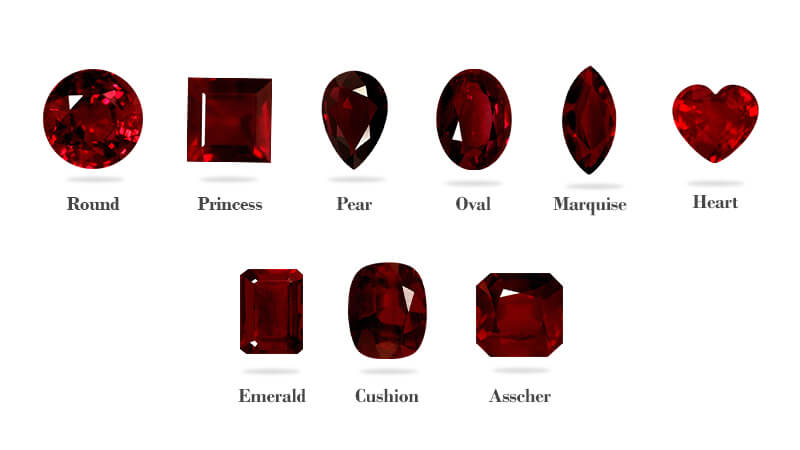
Colored gemstones come in a variety of forms and styles of cutting. Gemstones are typically faceted, much like diamonds, and come in a range of proportional geometric sizes. Certain gemstones, like Jade, Star sapphire, Star ruby, Opal, and many more, exhibit unique optical phenomena like stars and cat’s eye when cut in the classic dome shape known as a “cabochon.”
Classic gemstone shapes and cuts
Buying Tips for Gemstone Cut
- When you buy a gemstone, you should always go for the ideal cut gemstone with the desired shape. A good cut is something that may not cost more but can add or subtract a lot of gemstone beauty.
- You should always ensure that gemstone is properly polished and with perfect symmetry. The stone should be symmetrical in all dimensions so that it will appear balanced.
- When you buy a gemstone, you should give preference to wearer’s personal choice regarding the gemstone cut and shape.
Gemstone Color
The greatest distinguishing feature of a gemstone is its color. While certain jewels have more limited color palettes, the majority come in a wide range of hues. Experts examine the chromatic alternatives in terms of three crucial elements: hue, tone, and saturation, as the color phenomena in gemstones can become extremely complex. The gemstone’s primary color is hue. Color depth is represented by tone, which can range from colorless to black. The tones of gemstones are characterized as “light,” “medium-light,” “medium,” “medium-dark,” and “dark.” Lastly, saturation describes the primary color’s intensity or purity. Bright, intense, pure, rich, and vibrant colors are typically thought to be the greatest in the business. Gemstones that display a pure color with only faint hints of secondary colors are the most valued.

Medium is the ideal primary color—neither too light nor too dark. It is important to know color ranges and objective value assessments when purchasing gemstones, but it is essential to trust your eyes; if a specific color appeals to you, pay attention to it. Choose the gemstone that best suits your requirements.
Buying Tips for Gemstone Color
- When you buy a colored stone, you should give a close attention to the color of the gemstone. Gemstone should not be too dark or too light. Usually a gemstone with bright, rich, intense, pure, and vivid color is always best.
- The best way to see the true color of a gemstone is by looking at it against a white surface.
Gemstone Clarity
Inclusions are features that naturally occur in gemstones that were formed during the crystallization process. The beauty or attractiveness of a colored gemstone is not always diminished by inclusions. Finding gemstones free of inclusions or flaws is a challenging task. Gemologists will suspect that a gemstone is treated or manufactured if they cannot find any imperfections.
In certain instances, inclusions can enhance the beauty and value of a gemstone. The amazing visual phenomena known as cat’s eye and asterism, which are shown by the corundum (ruby and sapphire) and chrysoberyl crystal families, is caused by unique, needle-like inclusions.

Given that different geologic processes result in the creation of colored gemstones, it is typical for some gemstone types to contain more inclusions than others. jewels such as Aquamarine, Citrine, Tanzanite, Topaz, and Kunzite, for instance, are usually free of apparent inclusions, even at the microscopic level, whereas jewels like Emerald, Ruby, and Sapphire almost certainly do.
Buying Tips for Gemstone Clarity
- Usually colored gemstones are examined from the top or face up position. So when you buy a gemstone, you should examine it from the top and if an inclusion or flaw does not show in the face up position, then it will not affect the value and beauty much. In the same manner, if the gemstone setting hides an inclusion, then also it will not affect the value and beauty much.
- You can use jeweler’s magnifying glass loupe to examine gemstone’s imperfections.
- When you buy a gemstone, you should give more importance to its color instead of its clarity.
Gemstone Carat Weight
The unit of measurement used to weigh gemstones is called carat. A carat is equivalent to 0.20 grams or 200 milligrams. Gemstones are weighed in carats in addition to their size (mm). Due to varying proportions, two identically sized gemstones might have different weights. Because gemstones are less likely to be found in greater sizes, their prices are usually determined by the color and brilliance of the stone. As a result, the price per carat rises sharply as the carat weight increases over time.
Selecting the appropriate size is a subjective decision. You might be able to find the ideal piece at a price you can afford, with the exact appearance and emotional appeal you were looking for.

Buying Tips for Gemstone Carat Weight
- The carat weight of a gemstone will always depend on your budget. When budget is a strong factor, smaller stones have a significant advantage.
- You must buy an average sized gemstone with good color, cut and clarity instead of buying a larger gemstone with not so good color, cut and clarity.